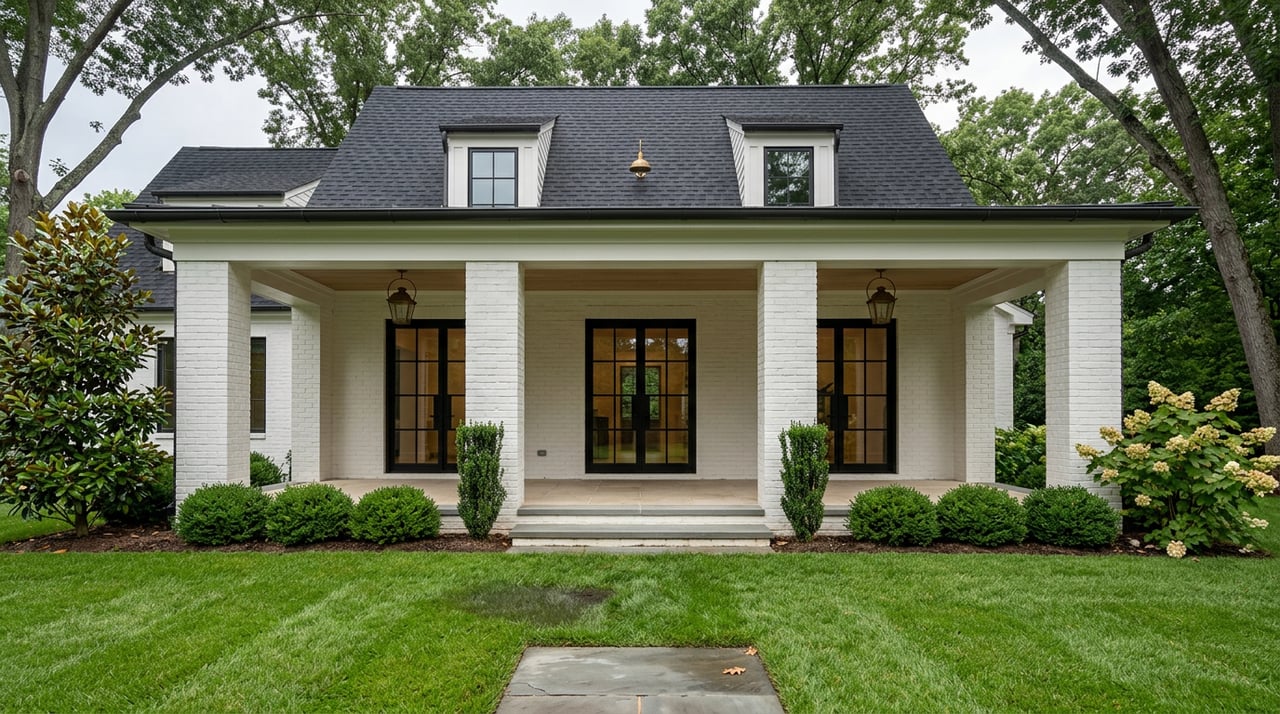
Why Milton's Price Premium Holds: The Zoning Mechanics Behind The 2026 Market
July 16, 2026
July 16, 2026
A buyer touring Milton in the morning and Roswell in the afternoon often leaves confused. Same commute radius, same school-quality tier, same North Fulton polish, and yet one market clears at roughly $1.1 million while the other trades in the mid-$500s. The instinct is to call it taste. The evidence points somewhere less romantic. Milton's premium is a zoning artifact, and the machinery producing it is being actively debated at City Hall right now.
That distinction matters at the offer table. If the premium were about lifestyle, it would soften with inventory. Because it is engineered into the land-use code, it doesn't.
The single most common Milton discovery, and the one that costs money to learn late, is the impervious surface cap. Under Milton's AG-1 agricultural district rules, which cover virtually all of the city's residential land, a lot's impervious surface coverage is capped at 20 percent on public roads and 25 percent on private ones. A buyer who signs a contract on a 1.2-acre lot picturing a pool, a sport court, a detached studio, and a widened motor court frequently finds that the builder has already used most of the available coverage on the house pad and driveway.
Building trends of larger homes and amenities are pushing the limits of existing development standards on smaller lots, and case studies from Milton's Community Development Department found the average home size has climbed above 5,200 square feet while average lot size fell to 1.86 acres in the 2021 through 2025 window. With builders maxing out a lot's impervious surface area, new homeowners are often left frustrated that they can't add features like a pool or deck later.
The takeaway for a buyer: read the survey, the site plan, and the current impervious calculation before you write the offer. On a Milton estate that already carries a 5,500-square-foot main house and a circular drive, the pool you assumed was a $180,000 line item may require a variance from the Board of Zoning Appeals before it is a line item at all.
The headline data confirms the premium is real and not seasonal noise. The nuance is in how far above the neighbors Milton actually sits.
| Market (June 2026) | Approximate median | Signal |
|---|---|---|
| Milton city-wide | ~$1.10M | 37 median days on market, 640 active listings |
| Milton luxury tier | ~$1.8M | $3M+ band slower, at 60+ days |
| Alpharetta | $700K–$800K | Comparable commute radius |
| Johns Creek | ~$700K | Comparable schools tier |
| Roswell | $550K–$650K | Comparable amenity access |
The comparison numbers are drawn from a June 2026 FMLS and Georgia MLS pull published by The Roundabout, which frames the point plainly: Milton runs 50 to 90 percent above its immediate neighbors and has done so consistently. A market can trade at a premium for a season on sentiment. It cannot hold a 50 percent spread against three adjacent cities without a structural reason.
The structural reason is that you cannot manufacture more Milton. Elsewhere in North Fulton, a five-acre parcel is a redevelopment opportunity. In Milton, it is five acres.
A single median is a poor guide to Milton because the market is really two markets stacked on top of each other.
Below roughly $1.8 million, buyers are chasing Cambridge High School attendance zones, newer construction, and lot sizes at or slightly above the one-acre AG-1 floor. This segment turns quickly. The Roundabout's June data shows well-positioned Cambridge-zone listings under $1.8 million pending in 20 to 30 days, while the $3 million-plus estate band routinely sits 60 days or longer as the qualified buyer pool thins.
Above $3 million, the picture changes. These are the properties inside The Manor Golf & Country Club, Atlanta National, White Columns, and the true acreage estates along Hopewell, Freemanville, and Birmingham. The Manor's Milton-address homes tend to trade in the $1.5M to $4M+ range, and industry commentary from local specialists puts the Milton-side address premium at roughly 10 to 15 percent over comparable Alpharetta-address homes inside the same community. Atlanta National sits closer to $1.8M to $3.5M+, and Kingsley Estates typically transacts in the $1.3M to $2.8M band. Each of these communities carries its own micro-market of appraisal comps, HOA covenants, and architectural review standards that a portal-level search will not surface.
A Milton comp is not a lookup. It is a construction. Two homes on the same road at the same square footage can carry a half-million-dollar spread because of zoning yield, tree canopy, and covenant depth.
The practical consequence: a buyer at $2.4 million has more real leverage in Kingsley Estates in a normal week than a buyer at the same number inside The Manor, where inventory is thinner and the address itself is priced in.
The premium exists because Milton's charter enforces low-density land use, and the code is currently in motion on three fronts that a serious buyer should track.
First, the AG-1 minor subdivision moratorium. Following a February 2026 public hearing, the City Council voted 6-1 to extend a moratorium of up to 120 days on applications for minor subdivision plats zoned Agricultural Residential, affecting land subdivided into lots exceeding three acres or any parcel divided into three lots or fewer. That is the exact size band where a Milton land assemblage could theoretically become several new estate lots. While the moratorium is in place, it isn't happening.
Second, the 2026 Comprehensive Plan Update. Milton is undertaking its five-year update required under the Georgia Planning Act, with the Comprehensive Plan Advisory Committee kickoff on February 5, 2026, and a June 29 open house that any buyer with a five-year horizon should read the outputs of. Any change to AG-1 lot minimums, lot width at the building line, or mixed-use envelopes along Highway 9 would move supply.
Third, the Deerfield form-based-code redevelopment at 13010 Morris Road. The 24.92-acre mixed-use proposal contemplates multifamily, townhome, and loft product alongside two existing six-story buildings. This is where Milton is allowing density to arrive: inside the Deerfield district, not across the estate market. Buyers who read the Deerfield vote as a signal that Milton is opening up more broadly are misreading it.
The signal these three items send together is coherent. Milton is releasing pressure through one small, defined district while tightening the rules that produce estate lots everywhere else.
For a buyer working across the Alpharetta-Milton line, the comp math is not a straight per-square-foot comparison. A defensible sequence looks like this:
Milton's median household income in ZIP 30004 sits near $172,000, which is why the market has been relatively insensitive to rate cycles the way medians closer to the national line have not. The buyer pool is deep enough that a 6 to 7 percent mortgage rate does not thin it materially. That is another reason not to underwrite a Milton offer expecting the same seller flexibility you would see two ZIP codes south.
Does a cash offer meaningfully lower the price in Milton? In the thin-inventory pockets, rarely. Cash generally compresses closing time and eliminates contingencies rather than trading dollars for certainty. In steadier communities like Kingsley Estates, cash has more room to negotiate list-to-close.
Is the June 29 Comprehensive Plan open house worth attending as a prospective buyer? If your time horizon is five years or longer, yes. The outputs of this update will shape the AG-1 rules, lot width standards, and Highway 9 mixed-use envelope for the rest of the decade.
How much of Milton's price is the school attendance zone versus the acreage? Both are priced in, and they don't separate cleanly. Cambridge zone sub-$1.8 million product turns fastest because it combines schools with a defensible lot. Above $3 million, the acreage and privacy tend to lead.
The Milton market rewards buyers who understand that they are buying into a land-use regime, not just a house. When the zoning is the product, the diligence has to be zoning-first.
For a private read on a specific street, community, or estate parcel and how the current AG-1 debate affects its value, Tasha Kline welcomes a confidential conversation and a personalized home valuation.
Stay up to date on the latest real estate trends.
Discover the finest homes North Atlanta has to offer. Stay connected to exclusive listings, market insights, and opportunities curated by a luxury real estate advisor with expertise in North Atlanta’s market.